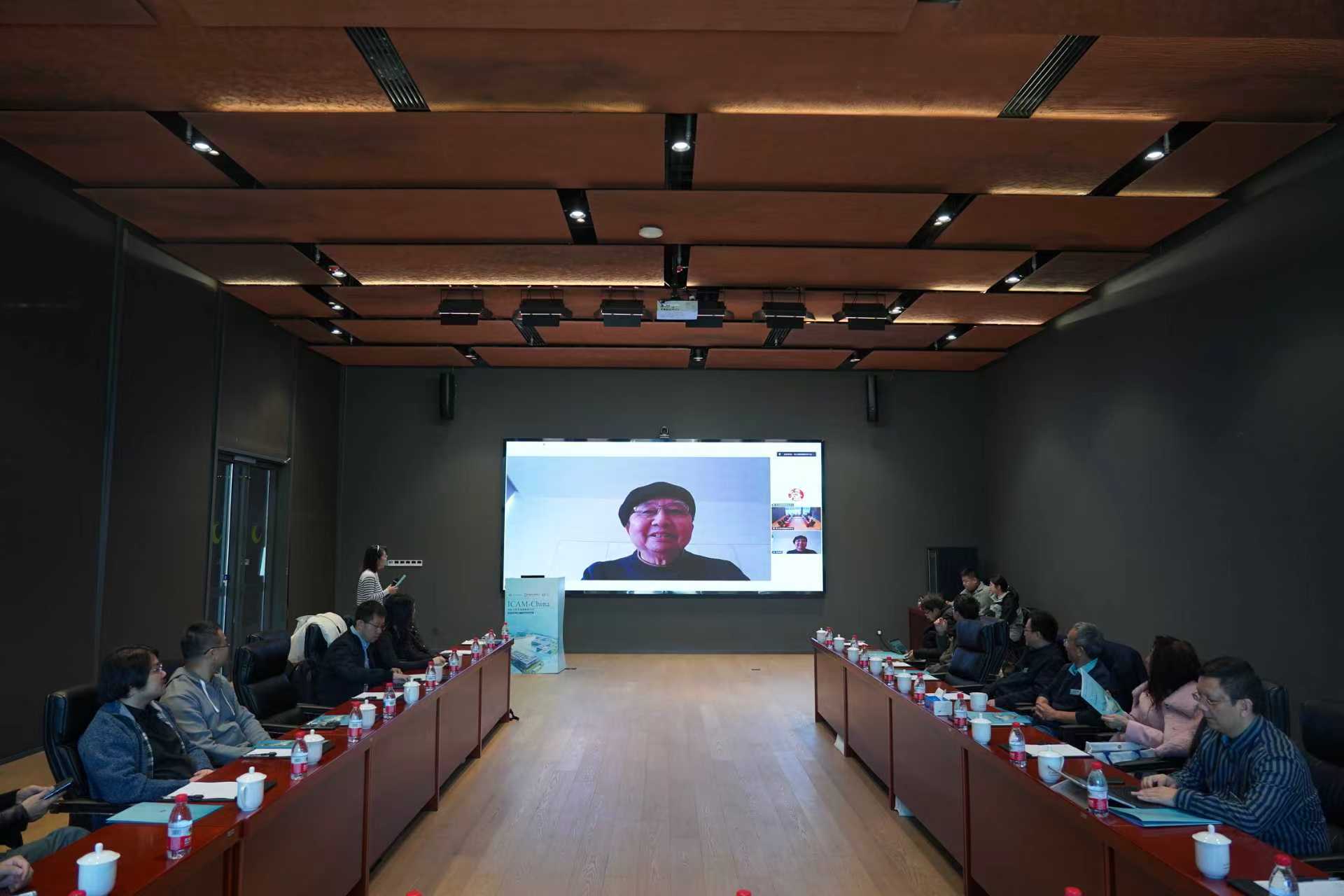
On November 20, 2025, the ICAM-China International Cooperation and Development Strategy Workshop was successfully held at the Yangtze River Delta Physics Research Center in Liyang, Jiangsu Province. Co-hosted by the Institute of Physics of the Chinese Academy of Sciences and the Kavli Institute for Theoretical Sciences, University of Chinese Academy of Sciences, the workshop focused on the future operation mode and development direction of ICAM-China, and facilitate international academic exchanges and cooperation of the ICAM institution. More than 20 experts and scholars from various universities and research institutions attended the workshop, including Academician Jin Kuijuan from the Institute of Physics of the Chinese Academy of Sciences, Gao Boxuan, representative of the International Organization Department of the Bureau of International Cooperation of the Chinese Academy of Sciences, Professor Zhang Zhenyu from the University of Science and Technology of China, Professor Zhang Hong from Sichuan University, and Professor Luo Jintuan from the Hong Kong University of Science and Technology.
Zhang Cui from the Institute of Physics of the Chinese Academy of Sciences presided over the opening ceremony of the workshop. Professor Zhang Fuchun, Director of the Kavli Institute for Theoretical Sciences at the University of Chinese Academy of Sciences, delivered an online speech. He first extended a sincere welcome and heartfelt thanks to all the guests and teachers present at the workshop, and reviewed the development history of the Institute for Complex Adaptive Matter (ICAM) in China. At present, the organization has grown into an academic community consisting of 27 well-known domestic universities and research institutions, covering multiple cutting-edge fields such as physics, chemistry, biology and materials, which fully demonstrates the vigorous vitality of interdisciplinarity and collaborative innovation.
Gao Boxuan, representative of the International Organization Department of the Bureau of International Cooperation of the Chinese Academy of Sciences, delivered a report entitled “The Construction and Development of the Mechanism for the International Organization Cooperation Platform of the Chinese Academy of Sciences”. He stated that ICAM-China has achieved remarkable results in its work over the past few years, and the Bureau of International Cooperation of the Chinese Academy of Sciences will continue to vigorously support the development of ICAM-China. He also suggested that ICAM-China fully leverage the resources of the Chinese Academy of Sciences to carry out domestic and international scientific and technological exchanges and cooperation.
Professor Luo Jintuan from the Hong Kong University of Science and Technology delivered a report entitled “Academic Exchange Through International Conferences at HKUST”, sharing the university’s experience in hosting international conferences in recent years. He introduced the strategic layout and innovative practices of promoting global scientific research cooperation through international academic conferences, bringing brand-new perspectives and cooperation opportunities to all participants.
Professor Zhang Hong from Sichuan University delivered a report entitled “The Development of First-Class Disciplines in Physics and the Program for Cultivating Top International Talents at Sichuan University”. The report pointed out that facing the new landscape of global scientific and technological competition and new trends in higher education development, the School of Physics of Sichuan University has carried out in-depth integration and systematic planning of first-class discipline development and the cultivation of top international talents, providing valuable references and insights for peer institutions.
As a platform for the collision of ideas and strategic planning, this workshop focused on discussions on how to deepen international academic exchanges by virtue of ICAM-China and stimulate cross-disciplinary collaborative innovation, laying a solid foundation for building a more closely connected international cooperation network.